|
How do teachers know if students are paying attention during direct instruction? This simple technique will keep student accountability high, generate a reliable study guide, and satisfy IEP requirements. Comment below to let us know how it goes-
SKELETAL LECTURE NOTES (Writing, Feedback, Collaboration) Description: This simple active engagement writing strategy assists students to stay focused during direct instruction (lecture), most especially in large classes. Students must listen closely during class in order to fill-in the pieces of omitted information. Application: Use in any subject that includes a lecture format. Process: Before class, create a handout that covers the lesson’s direct instruction piece. Omit some, but not all, key words such as specific people, places, events, and things. On class day, provide students with a handout of the day’s lecture. Warn students not to interrupt the lecture. During the presentation, emphasize those omitted words by pausing, repeating, or inflecting. Unless there is mass confusion, tell students there will be time for clarification of information with fellow students, not the teacher.
0 Comments
I have included two new icebreakers for you to try at the start of a new semester. Remember, you are always welcome to modify based on the level of your students. If you get a chance, let me know how you adapted the icebreakers and why.
ICEBREAKER: THREE FACTS ABOUT ME (Discussion, Collaboration) Description: This is a fun activity to do when students are meeting each other for the first time. Application: This is an icebreaker but can also serve as a review activity. Process: Hand out an index card to each student and direct them to write three of their interests, hobbies, and/or experiences (sports, music, reading, etc.) on the card. Remind them to put their name on the card. Gather cards. Have all students stand. Select one card, read aloud the first item and say, “Any student that does NOT have something similar, sit down. Read the second item aloud and say, “Only students who have both items in common remain standing.” Read the last item. If only one student remains standing, introduce the student. If more than one student remains, emphasize that they have many similarities, even though they may have attended different schools or live in different neighborhoods, etc. Repeat the process with another card and after activity, review cards to gain insight about each student. Ebony Matkins, CCECHS ICEBREAKER FOLLOW-UP: TAKE A STAND (Discussion, Collaboration) Description: The Icebreaker Follow-up: Take a Stand is perfect to end the first day of class as a sequel activity if there is at least twenty minutes of class left. It can also be used as an informal assessment best used with common misunderstandings. It combines elements of discussion with movement. Application: This activity can be used as an icebreaker, but also as an informal assessment in most subjects. Process: Before the very first day of class, prepare a list with numerous either-or statements. After the administrative duties that occur on the first day of class are over, engage students in an icebreaker activity that encourages discussion, camaraderie, and collaboration. Ask students to move desks toward the walls and gather around the open area. With masking tape, tape a line in the middle of the open area and announce that it is the “dividing line.” Explain to students that a statement will be read out loud and they will move to the side indicated. If a student is undecided, tell them to straddle the line. Examples: chicken or salad, mountain or beach, Pepsi or Coke, Gatoraid or Poweraid, Netflix or Hulu, football or basketball, thunderstorm or snowstorm, night owl or early riser, shy or outgoing, call or text, etc. (If used as an informal assessment, provide two options of commonly confused information: Display cloud formation: cumulus or nimbus, First President? Washington or Lincoln, Creator of Big Stick Policy? Teddy Roosevelt or Franklin, etc.) If you are a subscriber to the monthly bonus protocol and have switched emails, please make sure you let me know. Many thanks, Alison
It's not enough for students to answer questions. True critical thinking begins when students can formulate questions that seek to answer. This leads to internal dialogue which leads to more questions and better, more nuanced questions at that! Many teachers say they do not have time to insert a questioning strategy into their lessons. This month's protocol debunks the idea that student-led questioning takes too long with little return. Give it a try this fall and let me know how it goes.
10 X 10 QUESTIONING STRATEGY (Questioning, Discussion, Collaboration) Description: Sparking student questioning is at the heart of this simple, but effective protocol. Adapted from an article from Mentoringminds.com, 10 x 10 strategy limits time to promote “thinking focus” when students develop ten questions in ten minutes. Application: Use 10 x 10 to activate prior knowledge or interest in a topic, after reading or completing a unit of study. Process: Explain protocol prior to implementation. Display an easy-to-see visual timer set at ten minutes. Instruct students to create ten questions based on the learning in ten minutes. Encourage students to construct a variety of questions from knowledge-based to analysis/evaluative. Encourage quality of questions with “extra credit” enticement for questions used in whole group discussion. At the time-limit, collect work and select questions from submissions and discuss. Resources and for more information: Berger, W. (2014) Five ways to help your students become better questioners. Edutopia.org Stobaugh, R. Sparking Student Questioning, Mentoringminds.com Whether we are ready or not, AI is demanding a seat at the education table. But like anything that is new, those who use it must be accountable for understanding the good, the bad, and the ugly of it all. A teacher who uses the AI tool mentioned here MUST understand the implications and be able to justify its use. No doubt, this is a time saver of epic proportions for the beleaguered English teacher, but it is not without some potential problems. Explore! Try it out and let us know how it goes!
USING TECH: AI: GOTFEEDBACK (Feedback, Writing) Description: With a “if you can’t beat ‘em, join ‘em” mentality, gotFeedback is an AI tool for teachers to save time grading written work. From the website: “To receive good feedback from gotFeedback, (teachers) you need to create specific prompts. Using the Seven Keys to Effective Feedback by Grant Wiggins, gotFeedback has put together advice on how to create effective prompts for it to provide desired feedback . . .” AI or no, teachers should always read student’s work . Application: Use this tool to streamline feedback. Process: Go to www.gotlearning.com and explore the possibilities using the tool. From the information gathered, start small by assigning a fairly simple and straightforward prompt. Make sure students submit their work online. To access the feedback, upload or paste student text (word or PDF) into the gotFeedback box. Select the element of writing the AI tool needs to analyze: narrative structure, details in writing, claims in writing, and evidence in writing. Note that there is also a custom feature. (For the first few times the AI tool is used, make sure to read the original student work and form conclusions as to what feedback without AI assistance would look like in order to judge its value.) Once AI has analyzed the document, read the written evaluation, copy the text onto the student document and edit to provide “more personalized feedback.” Be ready to correct inaccuracies in the AI feedback. References or for more information: Byrne, R. (2023) Practical Ed Tip of the Week: gotFeeback- An AI Tool for Providing Feedback on Writing Freetech4teachers.com https://feedback.gotlearning.com/  This month's protocol focuses on the need for students to stop skimming and start understanding! This is just one way to use the method, but there are others out on the Internet! Look for "Fact Pyramid." READ, EVALUATE, RANK, & REASON (Reading, Writing, Discussion, Feedback) Description: Based on the “Fact Pyramid” activity, this protocol provides students with the opportunity to be accountable for their efforts by going beyond skimming text. Once students get acquainted with the method, it can be inserted into online, in-class, and homework assignments easily. See below for addendum. Application: Use in any subject that includes textbook readings, short stories, articles, primary source material, close reading, and fiction/nonfiction. With some modification, this method can be used to evaluate graphics and short videos. Process: Model method numerous times before students use it individually. Pre-select the reading material to be evaluated. In class, assign reading and tell students to highlight information they think is important. Hand-out graphic organizer (Addendum NNN). Instruct students to fill-in pyramid by rank ordering the top four bits of information from most (1) to least important (4). In the corresponding boxes, tell students to explain why they selected the rankings. Once completed, allow time for class talk, guiding, confirming, and clarifying points. To extend the learning, ask students to create an exit ticket summarizing the reading in one paragraph. Resources and for more information: Wiebe, G. (2012) “Fact Pyramid/Because Box” https://www.doingsocialstudies.com 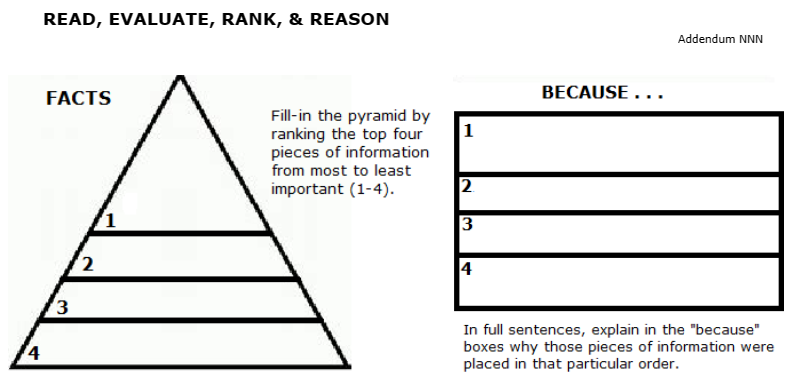  Hello Educators, This month's protocol can be used in any subject that has a writing component. It will take just a few minutes to clarify what the differences between revision and edit are and that may spark an "aha moment" that will last a lifetime. Good luck and email me if you have any questions. BACK TO BASICS: REVISE AND EDIT (Collaboration, Feedback, Discussion, Writing) Description: Proper peer editing does not happen by chance. Preparing students to edit a partner’s work is key if the goal is to maximize learning. This entry-level approach will not only explain the differences between revising and editing, but how to work well within a team structure. Other benefits include students being able to competently edit their own work as well as understanding various perspectives in the revision process. Application: Use in English Language Arts and any subject that lengthy written work is assigned. Process: Prepare students to use “Revise and Edit” strategy by asking students to answer what is the difference between revising and editing a paper. Elicit answers and clarify the concepts: “Revising makes writing sound better and editing makes writing look better.” Revising concentrates on the overall view or “big picture” of the work. Editing focuses on conventions of writing. Share this graphic: Depending on the original assignment and level of student, instruct them to concentrate on revising first, then, editing (or students can revise and edit at the same time). Model the strategy first so that students understand expectations. Resources and/or for more information: We Are Teachers (2014) 5 Peer Editing Strategies That Actually Work For Student Writers This month's protocol provides students the means to look at an issue from both sides and objectively make conclusions. As they advance in grade level, they should also mature in thinking and be willing to see others' points of view or that their conclusions may need revision. This protocol should always start with a reminder to students that differing opinions do not necessarily mean "right/wrong or good/bad." Let me know how it goes.
PRO AND CON GRID ASSIGNMENT (Collaboration, Discussion, Reading, Writing) Description: This collaboration strategy allows students to go beyond superficial talking points by thoroughly reviewing an issue, creating a list of pros and cons and making decisions based on the analysis of the information. Application: This method can be used in any subject when evaluating, for example, the pros and cons of a process or procedure, a technique, a conclusion, decisions or actions of a fictional character, a dilemma, a judgment, or a political decision. It can be used as the basis for a debate format or side notes when presenting direct instruction. Process: Find an issue that has clearly defined competing points of view. On class day, divide students into groups of four and within the groups of four, split into teams of two, labeling one team “Pro” and the other “Con.” Based on the topic, specify the minimum number of pros and cons each group must develop. Allow time for research but be ready to continue when students are finished. Allow time for teams to regroup and discuss findings. Elicit responses and record pros and cons by creating a T-chart labeled “Pro” and “Con” on the whiteboard OR create a Google Doc and ask students to complete it in real time. When finished, return to the whole group format, combine similar answers and denote the frequency of repetitive thoughts and use this as a springboard for students to make conclusions on the matter. To extend the activity, assign individuals a writing assignment based on the experience. Questions to include What was your position on the issue before the research, did that change? What were your group’s most compelling arguments on both sides? What did your group eventually conclude about the issue? Resources and for more information: Nine Alternatives to Lecturing. Centre for Teaching Excellence, University of Waterloo. Pro and Con Grid Online https://kb.wisc.edu/instructional-resources/page.php?id=104408 |
